

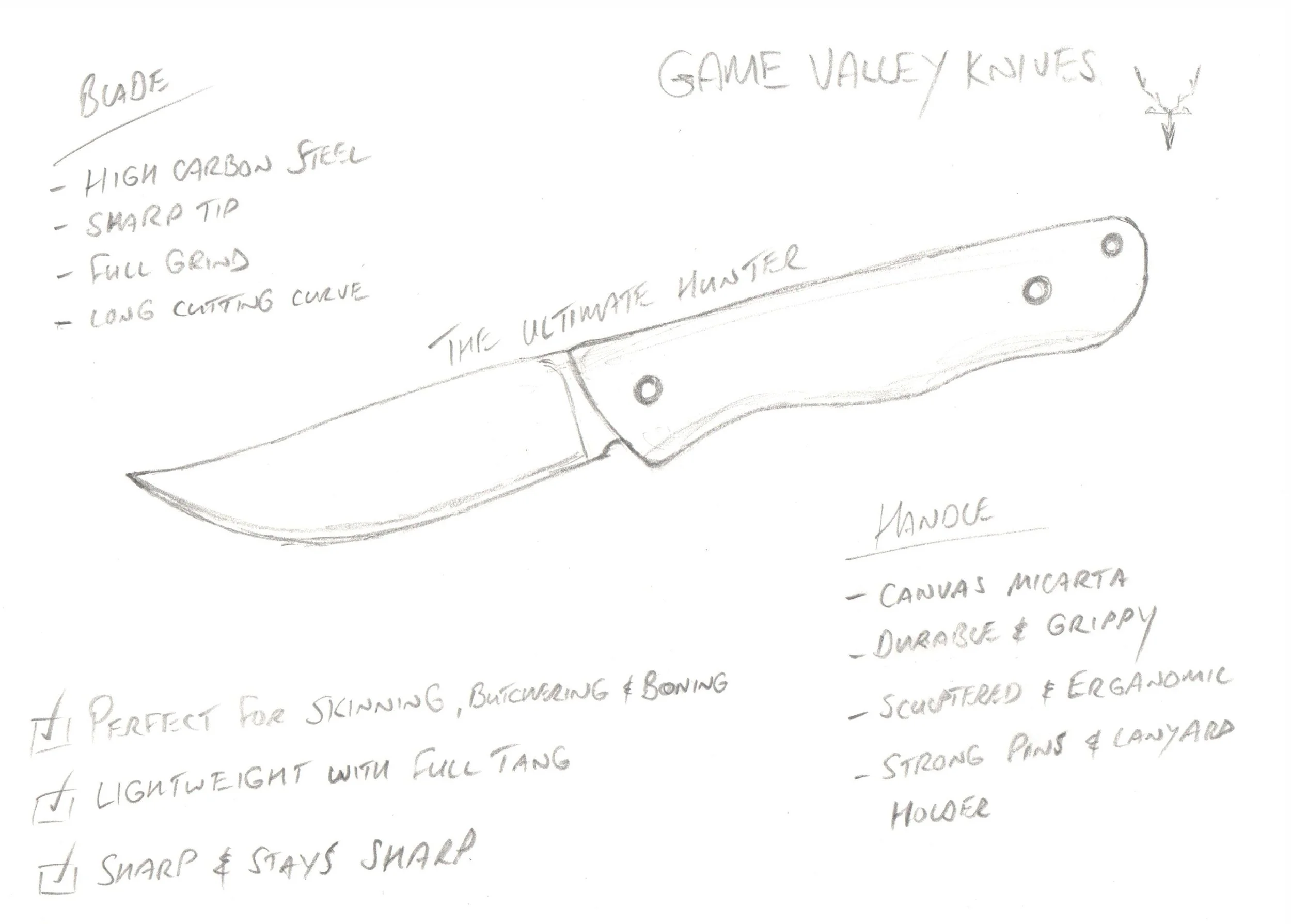
Every knife starts somewhere. Either it is an idea that has been sitting in the back of your mind or maybe it is a customer that has asked for something you hadn’t thought of. Other times, it's a knife that piques your interest and you want to copy its design and improve upon it.
My best estimate is that I’ve created 30% of Game Valley’s knives from scratch and I’ve copied or modified 70% of existing classic knife shapes. What you do cosmetically to your knives, whether they are your design or someone elses, is where you add the real value.
For example, the traditional Bird & Trout Knife has a wicked blade, is nice to look at, and has a clever forefinger slot. But is it comfortable to hold? Is it stainless steel or carbon steel? Is the handle appealing? A guaranteed seller for me is a carbon steel Bird & Trout knife with a NZ Rata handle featuring NZ Paua. Especially at the Nelson Market when its tourist/trout fishing season.
My top tip: The sooner you think of knives as functional art, the better. You will open up a whole new audience.
Starting with an Existing Design
One of the easiest ways to begin designing a knife is to look at examples of knives that already exist. There is a wealth of inspiration available online, from traditional hunting knives and classic kitchen knives to more contemporary designs.
I look at the overall shape, blade profile, handle proportions and smaller details that give a knife its character. Sometimes I like almost everything about a particular design, but feel that a few changes could make it better.
My next step is to print the knife at actual size on paper. This is important because a design that looks great on a computer screen doesn't always translate well into a knife you can comfortably hold and use.
With the full-size print I can start redrawing sections, adjusting curves, changing the handle shape or experimenting with a different blade profile. I'll often make several changes before I'm happy with the overall proportions.
The objective isn't simply to copy an existing knife. It's to use what works as a starting point and develop something with its own identity.
Starting with a Blank Sheet of Paper
My other approach is to start from scratch.
This is where a pencil, paper and a good eraser become essential!
I'll begin sketching ideas, playing around with different blade shapes, handle profiles and proportions. Sometimes the first sketch is close to what I'm looking for. More often, it's just the beginning of a process involving plenty of adjustments and a few discarded ideas.
One thing I find particularly useful is having an existing knife nearby for comparison. I'll use its handle length, blade length and overall dimensions as a reference. This helps keep my drawings realistic and ensures I'm working with proportions that make practical sense.
It's easy to draw an attractive-looking knife, but designing one that feels right in the hand and works as intended is another matter entirely.
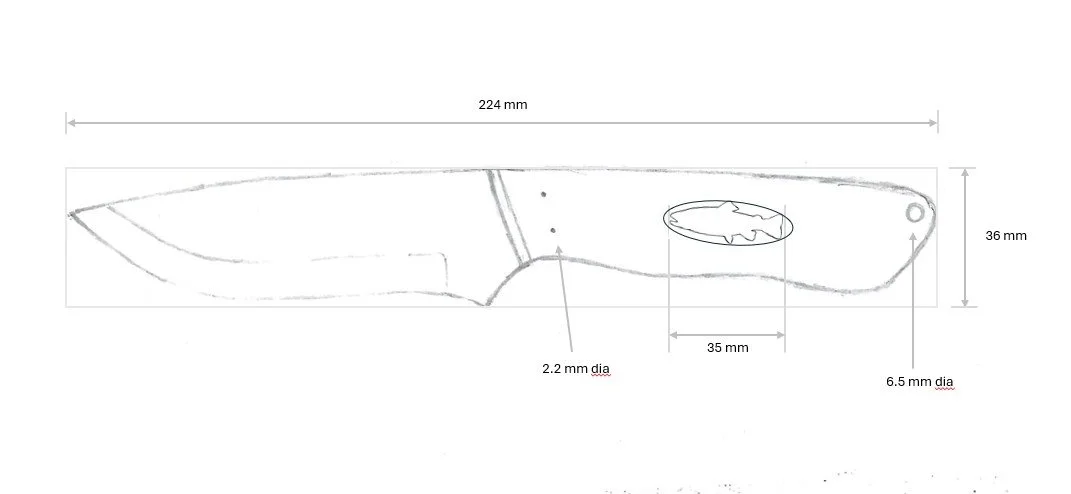
Form and Function Need to Work Together
A knife needs to look good, but appearance is only part of the equation.
The blade profile needs to suit its intended purpose. The handle needs to provide a comfortable and secure grip. The overall balance, proportions and ergonomics all need consideration.
A beautiful design that is uncomfortable to hold or impractical to use hasn't really achieved its purpose.
This is why I spend time refining the small details. A slight change to a handle curve or the transition between the blade and handle can make a surprising difference to the finished knife.
Don't Be Afraid to Make Changes
One of the most important things I've learned is not to become too attached to your first idea. Sometimes it works. Sometimes it doesn't. That's all part of the process.
I keep going until the design feels right, both visually and practically. Only then does it start to become a knife worth making. It still amazes me how a tiny change to a blade can make a massive difference to how it looks visually.
Look for Improvement
This is obvious… but if the design doesn’t work for you after you’ve made one or two of them, of if a customer provides valuable feedback, don’t be afraid to make changes to the design. Most knives are a work in progress.
Game Valley Knives – Elegance with an Edge. Enduring by Design.
